
Project management continues to evolve rapidly. Organizations now expect project managers to do more than manage schedules, budgets, and deliverables. Today’s project professionals are expected to lead teams, deliver business value, embrace agile and hybrid practices, manage uncertainty, use emerging technologies, and align projects with organizational strategy.
As a result, the Project Management Institute (PMI) has updated the Project Management Professional (PMP) certification exam to reflect modern project environments, emerging technologies, and changing business needs.
The updated PMP exam launched on July 9, 2026, with greater emphasis on business value, outcomes, stakeholder engagement, artificial intelligence (AI), sustainability, and real-world project scenarios.
At Learning Fortress, our PMP training program prepares professionals not only for the PMP examination but also for the realities of today’s project management profession.
Why PMP Certification Still Matters in 2026
The Project Management Professional (PMP) certification remains one of the world’s most recognized project management credentials.
PMP-certified professionals demonstrate their ability to:
- Lead project teams effectively
- Deliver business value and measurable outcomes
- Manage risks, issues, and stakeholders
- Apply predictive, agile, and hybrid approaches
- Align projects with organizational goals
- Navigate complex project environments
- Support organizational change
Organizations across industries continue to seek professionals who can successfully manage complex projects and connect project delivery with broader business objectives.
For professionals in Nigeria, PMP certification can also provide a structured way to demonstrate project management expertise across industries such as technology, healthcare, construction, telecommunications, banking, consulting, engineering, and professional services.
What Is the PMP Exam Structure in 2026?
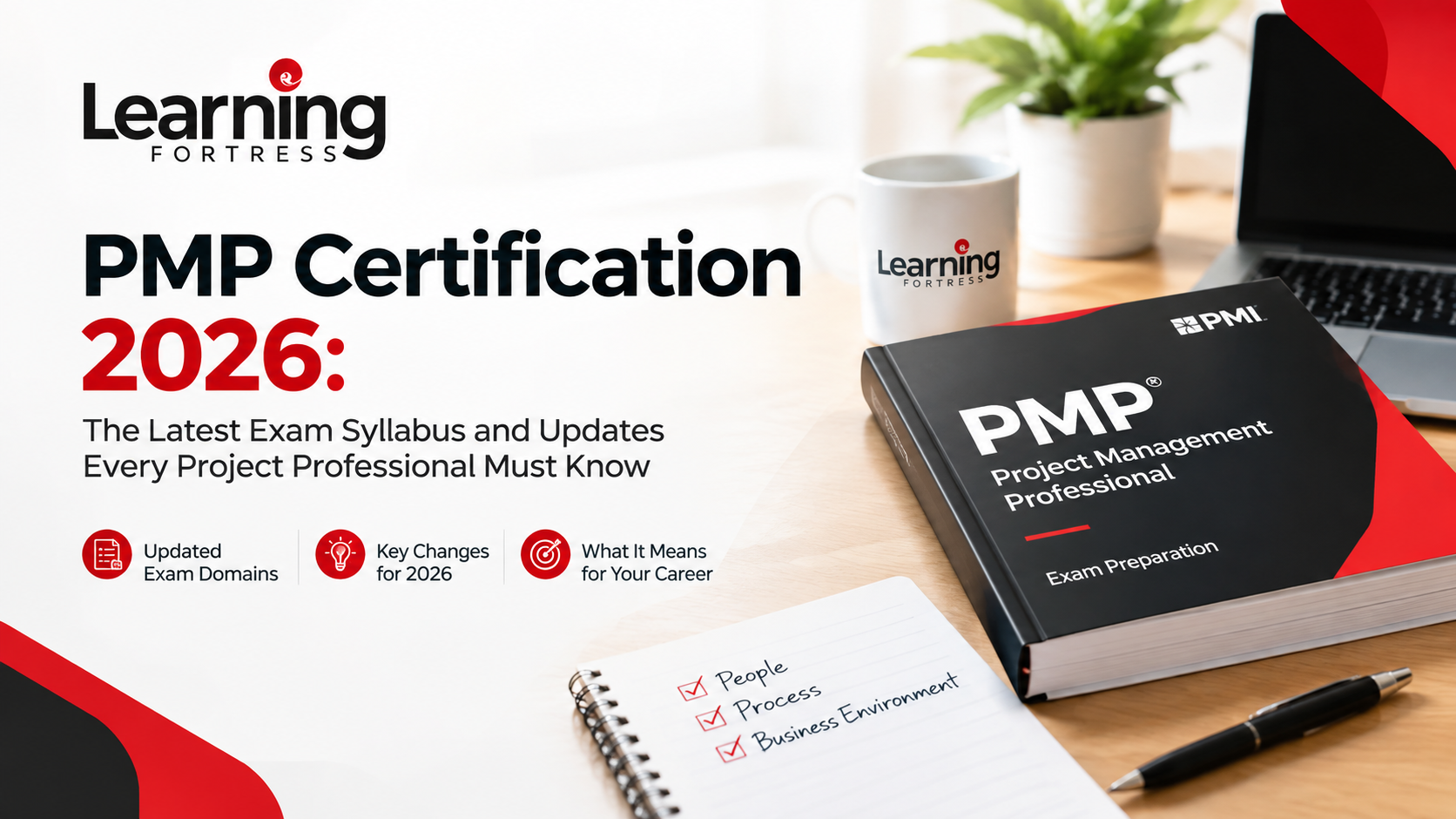
The 2026 PMP exam syllabus is organized into three major domains:
| PMP Exam Domain | Percentage |
|---|---|
| People | 33% |
| Process | 41% |
| Business Environment | 26% |
| Total | 100% |
The current PMP examination contains 180 questions and provides 240 minutes (four hours) to complete the exam. The exam also includes two 10-minute breaks.
The three domains are designed to assess a project professional’s ability to lead people, manage project delivery, and understand the wider business environment in which projects operate.
1. People – 33%
The People domain focuses on leadership, team development, collaboration, communication, and stakeholder engagement.
Key areas include:
- Conflict management
- Team building and development
- Stakeholder engagement
- Emotional intelligence
- Coaching and mentoring
- Servant leadership
- Supporting virtual and hybrid teams
- Collaboration and communication
- Creating an effective project team environment
The emphasis on people reflects the reality that successful project management is not simply about following processes. Project managers must be able to lead people, resolve challenges, build trust, and work effectively with diverse stakeholders.
2. Process – 41%
The Process domain covers the technical and delivery aspects of project management.
Topics include:
- Scope management
- Schedule management
- Cost management
- Risk management
- Quality management
- Change management
- Procurement
- Resource management
- Project planning and delivery
- Agile and hybrid delivery methods
The Process domain remains the largest component of the PMP exam. However, modern PMP preparation requires more than memorizing project management processes. Candidates must understand how to apply the appropriate approach to different project situations.
3. Business Environment – 26%
One of the most significant changes in the modern PMP exam is the increased emphasis on the Business Environment domain.
Topics include:
- Strategic alignment
- Organizational change
- Compliance and governance
- Benefits realization
- Value delivery
- Organizational strategy
- Business impact
- Sustainability
- Risk and regulatory considerations
PMI increased the Business Environment weighting from 8% to 26% in the 2026 exam, reflecting the growing importance of business context, strategy, and value delivery in project management.
What Has Changed in the PMP Exam in 2026?
The updated PMP certification exam syllabus for 2026 reflects several important developments in the project management profession.
Agile and Hybrid Project Management
Modern projects rarely follow a single methodology from beginning to end. Organizations increasingly use predictive, agile, and hybrid approaches depending on the nature of the project.
The 2026 PMP exam incorporates these approaches throughout all three domains rather than treating them as a separate section.
Candidates should understand:
- Agile frameworks
- Scrum concepts
- Hybrid project management
- Adaptive planning
- Iterative development
- Predictive approaches
According to PMI’s 2026 Exam Content Outline, approximately 40% of exam items represent predictive project management approaches, while the remaining 60% are divided between adaptive/agile and hybrid approaches.
This makes understanding agile and hybrid project management an important part of modern PMP exam preparation.
Value Delivery
Modern project management is increasingly focused on outcomes rather than simply completing a list of deliverables.
Project managers are expected to understand:
- What value the project is intended to create
- How project outcomes support organizational objectives
- How benefits will be measured
- How project decisions affect business performance
- How to align project delivery with stakeholder needs
The 2026 PMP exam places greater emphasis on outcomes, value, and business impact, reinforcing the idea that project success extends beyond delivering a project on time and within budget.
Strategic Thinking
Projects do not operate in isolation. They are connected to broader organizational strategies and objectives.
As part of modern PMP preparation, project professionals need to understand how to:
- Align projects with organizational strategy
- Evaluate business impact
- Support organizational change
- Understand governance requirements
- Make decisions based on project and business context
- Connect project outcomes to organizational value
Strategic thinking is therefore becoming an increasingly important capability for project managers.
Artificial Intelligence and Emerging Technologies
Artificial intelligence is changing how organizations plan, execute, monitor, and evaluate projects.
The updated 2026 PMP exam incorporates AI and emerging technologies into project-based scenarios, reflecting the increasing role of technology in modern project environments.
Modern project professionals may encounter technologies related to:
- AI-enabled decision support
- Digital transformation initiatives
- Data-driven project management
- Technology-enabled collaboration
- Automated project workflows
- AI-supported analysis and planning
The objective is not simply to understand technology, but to understand how emerging technologies can affect project decisions, risks, stakeholders, and value delivery.
Sustainability and Governance
Sustainability, governance, ethics, and compliance are also increasingly relevant to project management.
Project professionals may need to consider:
- Environmental and social impact
- Governance requirements
- Compliance obligations
- Ethical decision-making
- Regulatory requirements
- Sustainability risks
- Organizational policies and standards
The updated PMP exam incorporates sustainability and related considerations into project scenarios, reflecting the broader responsibilities of today’s project professionals.
How Has the PMBOK Guide Evolved?
Project management standards have also evolved significantly.
Modern PMI guidance places greater emphasis on:
- Principles-based project management
- Value delivery
- Performance domains
- Tailoring approaches
- Agile and adaptive practices
- Leadership
- Strategic thinking
- Business acumen
This evolution reflects a broader shift in project management. Professionals are expected to apply judgment and adapt their approach rather than simply follow a fixed set of processes.
For PMP candidates, this means preparation should focus on understanding project management concepts and applying them to realistic scenarios, rather than relying solely on memorization.
What Are the PMP Certification Requirements in 2026?
Before applying for the PMP exam, candidates need to meet PMI’s education, project experience, and training requirements.
Depending on your educational background, PMI currently provides several eligibility pathways. For example:
- A secondary/high school diploma plus five years of project management experience
- An associate degree or vocational qualification plus four years of project management experience
- A bachelor’s degree or higher plus three years of project management experience
- A bachelor’s or postgraduate degree from a PMI GAC-accredited program plus two years of project management experience
Candidates also need 35 hours of project management education/training, unless they qualify through an active CAPM certification. PMI states that qualifying project experience must fall within the previous 10 years.
Because PMI periodically updates its requirements, candidates should confirm their eligibility directly with PMI before submitting an application.
Who Should Take PMP Training?
PMP certification is designed for professionals who are responsible for leading projects, teams, initiatives, or organizational change.
PMP training can be particularly valuable for:
- Project Managers
- Team Leads
- Program Managers
- Business Analysts
- Operations Managers
- Engineers
- Consultants
- Product Managers
- IT Professionals
- Aspiring Project Leaders
Whether you work in technology, construction, healthcare, finance, telecommunications, consulting, engineering, or another industry, PMP training can help you develop project management capabilities that apply across different sectors.
For professionals looking for PMP training in Nigeria or Lagos, choosing a program that reflects the current 2026 exam content is particularly important.
Why Choose Learning Fortress for PMP Training?
Preparing for the PMP exam requires more than simply reading project management materials. Candidates need structured learning, practical examples, exam preparation, and opportunities to apply what they learn.
At Learning Fortress, our PMP training provides:
- An updated curriculum aligned with current PMP requirements
- Experienced instructors
- PMP practice examinations
- Real-world project management case studies
- PMP application support
- Exam preparation strategies
- Flexible virtual learning options
Our goal is to help professionals develop both the knowledge required for the PMP certification exam and the practical project management skills needed in today’s workplace.
Whether you are looking for PMP training in Lagos, online PMP training in Nigeria, or a flexible professional development program, Learning Fortress can help you prepare for the modern project management environment.
Important PMP Training Requirement Update for Late 2026
Professionals planning to take the PMP exam should also be aware of an upcoming PMI training eligibility change.
PMI currently states that from December 1, 2026, live PMP training used to meet the application requirement will need to be delivered by an eligible provider pathway, including a PMI Authorized Training Partner (ATP), a qualifying China Registered Education Provider, or an eligible accredited academic program. Training completed before December 1, 2026 remains eligible under the current requirements.
If you are planning your PMP certification journey in late 2026, it is therefore important to verify that your chosen training provider meets PMI’s current requirements before enrolling.
PMP Certification in Nigeria: Is It Worth Considering?
PMP certification is relevant to professionals across Nigeria who manage projects or are building careers in project management.
The certification can be relevant across sectors including:
- Information technology
- Healthcare
- Banking and financial services
- Construction
- Telecommunications
- Engineering
- Government and public-sector projects
- Consulting
- Energy
- Manufacturing
- Professional services
For Nigerian professionals, PMP training can provide structured preparation for the international PMP examination while developing project management knowledge that can be applied to projects locally and internationally.
The decision to pursue PMP certification should ultimately depend on your career goals, existing project experience, eligibility, and the requirements of the roles you want to pursue.
The Future of Project Management
The role of project managers continues to expand beyond schedules, budgets, and task management.
Today’s project professionals are expected to be:
- Leaders
- Strategists
- Change agents
- Problem solvers
- Stakeholder managers
- Value creators
- Technology-aware decision makers
The 2026 PMP exam update reflects this changing role by placing greater emphasis on business outcomes, value delivery, leadership, AI, sustainability, stakeholder engagement, and real-world project scenarios.
Earning your PMP certification can help demonstrate the knowledge and capabilities required to lead projects in increasingly complex and dynamic environments.
At Learning Fortress, we are committed to helping professionals develop the knowledge, skills, and confidence required to succeed in the modern project management landscape.
Start Your PMP Journey in 2026
If you’re considering PMP certification in 2026, now is the time to understand the updated exam syllabus, confirm your eligibility, and prepare with current study materials.
The PMP exam has evolved, but its core purpose remains the same: developing project professionals who can lead effectively, deliver value, and navigate complex project environments.
Your PMP journey starts here.
Ready to begin your PMP training? Explore Learning Fortress’s PMP training program or contact our team to learn more about upcoming training options.
Frequently Asked Questions About PMP Certification 2026
What is the PMP exam syllabus for 2026?
The 2026 PMP exam is divided into three domains: People (33%), Process (41%), and Business Environment (26%). Predictive, agile, and hybrid approaches are assessed throughout the three domains.
How many questions are on the PMP exam in 2026?
The PMP examination contains 180 questions and has a four-hour, or 240-minute, time limit. Candidates also receive two 10-minute breaks.
Is the PMP exam changing in 2026?
Yes. PMI launched an updated PMP exam on July 9, 2026. The update places greater emphasis on outcomes, value, business impact, AI, sustainability, stakeholder engagement, and real-world project scenarios.
How much of the PMP exam is agile or hybrid?
PMI’s 2026 Exam Content Outline states that approximately 40% of exam items represent predictive approaches, while the remaining 60% are divided between adaptive/agile and hybrid approaches.
What are the PMP certification requirements?
PMP eligibility depends on your education and project management experience. Depending on your qualification, PMI requires between two and five years of relevant project management experience, together with 35 hours of project management education or an active CAPM certification.
Where can I get PMP training in Nigeria?
Professionals in Nigeria can choose from different PMP preparation options, including online and instructor-led training. When choosing a provider, candidates should ensure that the training meets PMI’s current requirements and prepares them for the current PMP exam content.
Is PMP certification useful for project professionals in Nigeria?
PMP certification is an internationally recognized project management credential and can be relevant to professionals working across Nigerian and international organizations. Its relevance will depend on an individual’s career goals, experience, industry, and target roles.
Ready to start your PMP certification journey?
Explore Learning Fortress PMP Training and take the next step toward developing the project management skills required for today’s global workplace.
You May Also Like
-
Sep 16, 2026
CBAP Certification & Business Analysis Training | Learning Fortress Learn about CBAP certification, business analysis careers, BABOK, and the skills...
-
Sep 16, 2026
PMP Certification 2026: Benefits, Career Opportunities & Training Discover the benefits of PMP certification in 2026, who should take PMP...
Sign up to receive our latest updates
Get in touch
Call us directly?
+234 702 666 4333
Address
15 Ihuntayi Road, Oniru Rd, Victoria Island, Lagos 100252, Lagos, Nigeria
info@learningfortress.com